

The Course That Changed Everything Cost Nothing
I bought every course going. The real training was free.


I need to make a confession. And it’s slightly embarrassing, given that I spent decades in marketing and media and should really have known better.
In my first year of starting over, I spent thousands of pounds on training courses. Thousands. I stopped counting after it got properly uncomfortable. And I’m not talking about one big investment in something transformative. I’m talking about a slow, creeping accumulation of six-week programmes, online masterclasses, webinars-that-turned-into-upsells, and courses with names like “Build Your Six-Figure Business in 90 Days” that I purchased at 11pm on a Tuesday when I was feeling particularly wobbly about whether I knew what I was doing.
Reader, I did not build a six-figure business in 90 days.
What I did build was an impressive collection of logins I’d forgotten, PDFs I’d downloaded but never opened, and a growing sense that perhaps the problem wasn’t that I lacked skills. The problem was that I lacked the confidence to trust the ones I already had.
Let me back up.
Eighteen months before the course-buying spree, I was a Senior Director at Google. I’d been there for a decade. Before that, I’d spent years climbing through marketing, media, and advertising at some of the biggest companies in the world. I’d run campaigns that reached billions of people. I’d presented to rooms full of executives. I’d managed teams, budgets, crises, and the kind of corporate politics that would make your eyes water.
And yet. The moment I stepped out of that building and into my new life as an entrepreneur, something happened that I wasn’t prepared for.
I forgot all of it.
Not literally, obviously. I could still remember what I’d done. But it was as if my professional confidence had been housed inside a building with a security pass, and when I handed back the pass, the confidence stayed behind. I was standing on the other side of the glass doors with decades of experience and absolutely no idea how to use it.
So I did what any sensible, terrified person does when they don’t trust themselves. I went looking for someone else to tell me what to do.
Enter the training courses.
The Seduction of Preparation
The first one seemed reasonable. It was about building an online presence. I’d spent my career building brands for other people, but building one for myself felt completely different. So I signed up. It was fine. I learned some things I already knew, presented in a slightly different way. I felt temporarily reassured.
Then came the second course. And the third. Personal branding. (The irony of a brand strategist taking a personal branding course is not lost on me.) Each one promised to fill a gap I was convinced existed. Each one delivered enough to make me feel like I was making progress without actually requiring me to do the scary bit.
Which was, of course, the actual doing.
This is the trap nobody warns you about when you start over. It’s not the lack of knowledge that gets you. It’s the seduction of preparation as a substitute for action. Every course you take, every framework you learn, every certification you add to your LinkedIn profile feels like progress. It feels like you’re getting ready. And readiness feels safe.
But readiness is a lie.
The Messy Truth
I know that now because of what happened when I finally stopped preparing and started doing. And what happened was messy, imperfect, occasionally mortifying, and the single most useful learning experience of my entire professional life.
Here’s the bit that’s hard to admit: my first client was wrong for me and I knew it from day one but said yes anyway because I was scared that if I said no, nothing better would come along.
That “failure” taught me more in a week than six months of online courses had.
Because here’s what training courses can’t give you: the specific, personal, sometimes painful feedback that only comes from doing your actual work in the actual world with actual people responding to it.
A course can teach you the theory of audience building. It cannot teach you what YOUR audience responds to.
A course can give you a framework for pricing. It cannot tell you what it feels like to name your price for the first time and have someone say yes (or, more usefully, have someone say no and then figure out what that means).
A course can show you how someone else built their business. It cannot show you how to build yours, because yours doesn’t exist yet and the only way to find out what works is to start building it.
Tiny Experiments Changed Everything
I call this the Tiny Experiments approach (as inspired by Dr Anne-Laure Le Cunff’s Tiny Experiments book) and it’s what actually changed everything for me.
Instead of signing up for another course, I started running small, low-stakes experiments:
What happens if I post this on LinkedIn?
What happens if I reach out to that person?
What happens if I try this format, this topic, this angle?
What happens if I say what I’m actually thinking instead of what I think I’m supposed to say?
Some experiments worked. Many didn’t. The ones that didn’t work weren’t failures. They were data. They told me something specific about what I should do next. And because they were tiny, the stakes were low enough that failing didn’t send me into a spiral. It just sent me into the next experiment.
The best bit? I started moving. Actually moving. Not “preparing to move” or “learning about moving” or “watching other people move and taking notes.”
Moving.
And movement is everything.
It’s Not a Knowledge Gap. It’s an Action Gap.
Here’s what I wish someone had told me on day one of my new life: the gap between where you are and where you want to be is not a knowledge gap. It’s an action gap. You probably already know enough to start. You definitely know more than you think. The skills you built over decades didn’t evaporate when you changed your job title. They’re still there. They just need a new context.
I think about the women I admire most in this space, and not one of them credits a training course for their success.

Trinny Woodall didn’t take a “How to Launch a Beauty Brand at 54” course. She knew makeup, she knew her audience, and she started.
Falguni Nayar didn’t do a twelve-week programme before leaving investment banking at 50 to build Nykaa. She saw the gap and she went for it.
Gail Becker didn’t have a food industry background when she launched Caulipower at 57. She had a problem (no decent gluten-free food for her sons), corporate experience she could repurpose, and the willingness to figure the rest out as she went.
What they all had in common wasn’t a course. It was momentum. The willingness to start before feeling ready. The understanding that doing it is the training for it.
A Caveat (Because I’m Not a Monster)
Now, am I saying all training courses are a waste of money? No. Some are brilliant. Some will genuinely teach you a specific technical skill you don’t have and need. If you can’t use a particular piece of software, learn it. If you’re entering a regulated industry and need a qualification, get it.
But if you’re buying courses because you’re scared, if you’re using “learning” as a way to avoid the vulnerability of actually putting yourself out there, if you’re telling yourself “one more course and then I’ll be ready,” I want to lovingly but firmly tell you:
You’re ready now. You’ve been ready for a while.
The course you need is the one you design yourself. It’s called: try it, see what happens, adjust, try again.
What I Actually Do Now
I eventually did get comfortable with this approach, and it was genuinely liberating. I stopped asking “what don’t I know?” and started asking “what do I already know that I’m not using?” The answer, it turned out, was quite a lot.
Decades of building brands for other people had taught me how to tell stories, how to be visible, how to make ideas stick in people’s minds. I just had to learn to do it for myself instead of for a corporation. And no course was going to teach me that. Only doing it would.
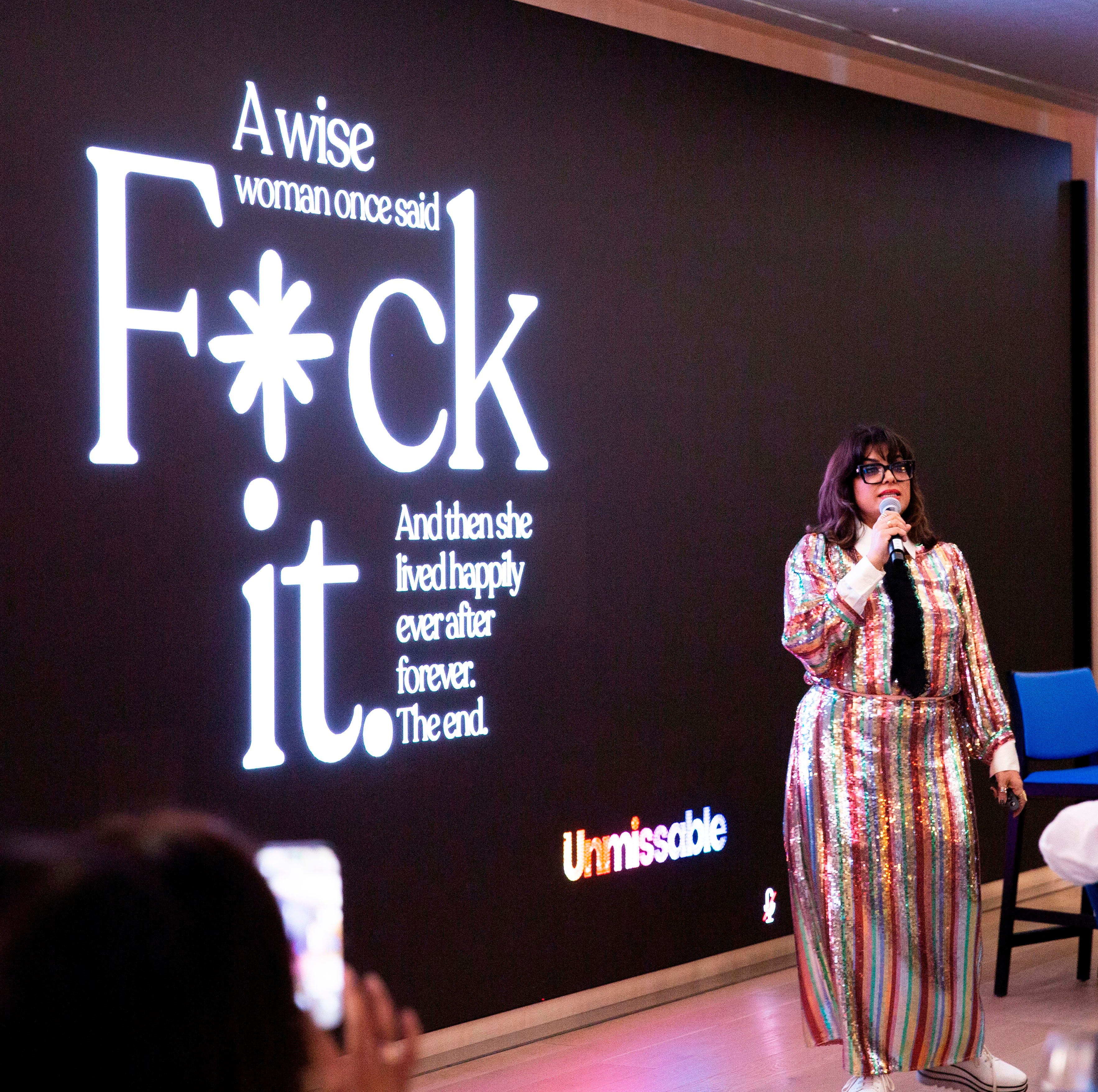
Your Fuck-It List
So here’s my completely unqualified, non-certified, learned-it-the-hard-way advice for anyone standing where I was two years ago:
Write a list of what you’d do if you stopped waiting to be ready. I call mine a Fuck-It List, because that’s the energy it requires. Not “someday.” Not “when I’ve finished this course.” Now.
Then pick one item and turn it into the smallest possible experiment. Not the finished product. Not the perfect version. The tiniest, most imperfect, slightly embarrassing first attempt.
Do it this week.
See what happens. Learn from it. Do the next one.
That’s the only course you need.
And if it helps, know that I’m still running tiny experiments every single week. Some of them are brilliant. Some of them are absolute disasters. All of them teach me more than any PDF ever did.
I made a video recently about the three stages of starting over: the fears, the leap, and what happens on the other side. Everything I’ve written about here, plus the stories of some extraordinary women who proved that starting late is actually starting strong. You can watch it on my YouTube channel (link at the bottom).
And if you’re sitting there right now with a browser tab open on a course checkout page, close it. Open a blank document instead. Write your Fuck-It List.
Then start.
Watch here

P.S. I now help ambitious people go from invisible to unmissable to growth - using the power of stories, AI and audacity!
I’m a speaking and storytelling advisor, working with entrepreneurs, execs, creators, and business leaders to help them say something that matters and ensure others deeply care. My approach is to prioritise resonance over reach to grow your business, audience, and cause.
If you think I can help you or your business - please get in touch.
This post has given me the nudge (shove) I really needed in the middle of a grey month where I just want to hide! THANK YOU. One step, one action. One more bit closer!